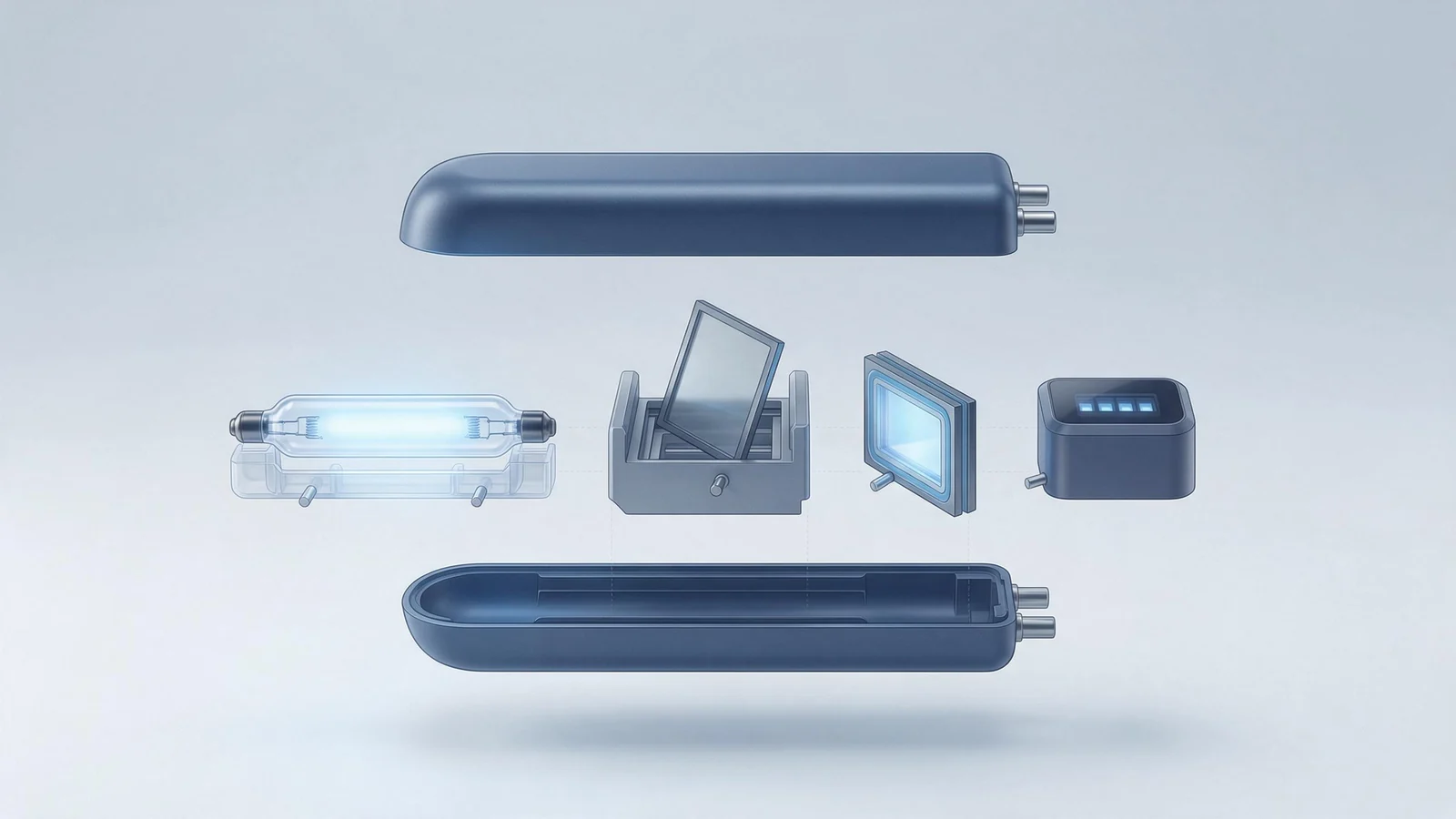
What an IPL handpiece actually contains
Strip the housing off and the parts are few. A xenon flashlamp sits at the back. A reflector wraps around it to throw light forward. Then a cut-off filter, then the sapphire output window that contacts skin. Cables run back to the console carrying both optical energy and control signals. That's the whole chain.
The lamp itself fires broadband light. It isn't a laser, and that distinction matters more than most buyers realise. An IPL Therapy Systems 510(k) summary puts it plainly: IPL is different from lasers in that IPL delivers many wavelengths in each pulse of light instead of just one wavelength (FDA 510(k) summary K101901). So the handpiece is a filtering and delivery device, not a beam generator. You select a slice of that broadband output, and the slice you select decides which chromophore you're actually targeting.
Here's the part buyers underweight: the console mostly stores energy and fires the pulse. The handpiece decides spot size, filter cut-on, cooling, and the geometry of how light meets tissue. Swap handpieces and you've changed the treatment. That's why a dead handpiece stalls a room even when the console is fine.
Cut-off filters and wavelength selection
A cut-off filter is a coated glass element that blocks short wavelengths and passes longer ones. Block the short end and you push the output toward deeper targets. It's a physical gate, not a software setting.
The regulator language is a useful sanity check here. The GSD Intense Pulsed Light System 510(k) states that intense pulsed light energy wavelengths from 500–1200 nm are indicated for treatment of pigmented lesions, hair removal, and treatment of vascular lesions, while 400–1200 nm is indicated for the treatment of acne (FDA 510(k) summary K091664). Different windows, different indications. Your filter set is your clinical menu.
On our platform the options are explicit. The MF-05 handpiece delivers filtered IPL in the 530–1200 nm range, with filter options of 530–1200 nm for rejuvenation, 585–1200 nm for vascular, and 610–1200 nm for hair. Anything below 400 nm is rejected. Filters are swappable, and swapping is routine setup, not a repair. You'll do it between patients.
One naming note, because suppliers mix terms. Some catalogues say cut-on filter, some say cut-off. They describe the same element from opposite ends: the wavelength it passes from, or the wavelength it blocks up to. Ask which convention a quote uses before you compare two quotes line by line.
Xenon lamp life and the shot counter
The xenon flashlamp is the wear item. Nothing else in the handpiece degrades on every pulse the way the lamp does.
Life is rated in shots, and you should treat that number as a planning figure, not a guarantee. Our device manuals rate the xenon lamp in the MF-05 handpiece at about 60,000 shots. That's your denominator. If a room runs 1,500 shots a week, you're looking at roughly forty weeks before the rated figure is reached, and output will have drifted well before the lamp stops firing entirely.
Which brings us to the shot counter. Read it at the start of every treatment day, not once a quarter. Log the number. Then work a simple rule: when you cross 80% of rated life, order the relamp kit and book the service window. A lamp that fails mid-course on a booked patient costs you the appointment, the goodwill, and the room hour. A lamp you replace on a Tuesday morning costs you a Tuesday morning.
Fluence matters to lamp life too. Higher energy settings draw harder on the lamp, so a clinic running vascular and hair work at the top of its range will burn through shots faster in calendar terms than a rejuvenation-only room. Track shots per patient, not just shots per month. For the arithmetic, see our breakdown of lamp life and cost per shot, and for the wider service rhythm, the IPL machine maintenance schedule.
Contact cooling and the sapphire output window
The output window is sapphire because it passes the full IPL band, survives repeated thermal cycling, and conducts heat away from skin. It's actively cooled. On the MF-05 the output window is sapphire contact-cooled.
Cooling isn't a comfort feature bolted on at the end. It changes what you can safely deliver. A study of 25 patients with leg telangiectasias used a device that circulates water around the IPL crystal in contact with the skin to provide continuous cooling in the 1 °C to 4 °C range. In that study, the fluence on the site receiving contact cooling was increased by 10%. Outcomes separated too: cooled sites showed 10 improved, 5 unchanged and none worsened, while uncooled sites showed 7 improved, 5 unchanged and 3 worsened (P<.05). Epidermal injury involving hyper- or hypopigmentation, crusting, or vesiculation was not observed at any cooled site but was recorded in three noncooled sites (PubMed 11096386).
Translation for a buyer: a handpiece with degraded cooling forces you to drop fluence, and dropping fluence costs you efficacy. It also raises the risk profile on darker skin types, where post-inflammatory hyperpigmentation is already the concern you're managing. If your patient list includes Fitzpatrick IV to VI, cooling condition is a clinical variable, not a maintenance detail.
Inspect the crystal before every session. Look for chips at the edge, clouding under the surface, and residue build-up. A chipped window concentrates energy and scorches. A cloudy one silently cuts your output. Both are reasons to pull the handpiece from service that day.
Cables, connectors, and handpiece compatibility
The handpiece cable carries optical energy and control signals in the same bundle. That's why a cable failure can present as a console fault, a flickering display, or an intermittent no-fire that only shows up at certain angles. Wiggle the cable at the strain relief during your pre-treatment check. If the shot counter or the ready lamp stutters, you've found something.
Connector type and pinout must match the console before anyone orders a replacement. This is where clinics lose weeks. Two handpieces can look identical, fit the same bracket, and still be incompatible because the connector keying or the pin assignment differs between production runs.
So when a supplier asks for the existing connector, they aren't being difficult. They're protecting you. Photograph the connector face, count the pins, note the keyway position, and write down the console model and serial. Send all of it with the enquiry. A quote built without that information is a guess.
| Part | What it does | Typical first symptom of wear | Service path |
|---|---|---|---|
| Xenon flashlamp | Generates the broadband pulse | Falling output at unchanged settings | Relamp |
| Cut-off filter | Blocks short wavelengths | Discolouration, coating damage | Filter swap |
| Sapphire window | Transmits light, cools epidermis | Chips, clouding, residue | Crystal replacement |
| Cable and connector | Carries energy and control signals | Intermittent firing, display faults | Cable or handpiece replacement |
What wears out first and what replacement involves
Order of failure, in our experience of the platform: lamp first, crystal second, cable third, filter last. Your mix will vary with volume and technique.
Two service paths exist and buyers conflate them. A relamp keeps your housing, your connector, and your existing crystal, and replaces the lamp. A full handpiece replacement swaps the whole assembly. Relamp is the cheaper, faster path when the crystal and cable are sound. Replacement is the right call when the window is chipped, the connector is damaged, or the housing has taken a knock.
- Pull the handpiece from service and tag it with the date and the shot counter reading.
- Photograph the connector face and the crystal surface before packing.
- Confirm with the supplier whether the path is relamp or full replacement, in writing.
- On return, verify output against your normal settings before the first patient.
- Log the new lamp's start shot count and reset your relamp planning figure.
Calibration or output verification should follow any repair. Ask what the supplier provides as a record. We can't tell you what a given supplier will hand over, and neither can a brochure. Ask for the verification method, the reference instrument used, and a dated record you can file against the handpiece serial. If a supplier can't describe how they verify output after a relamp, that's your answer.
On arrival, inspect before you install. Check the crystal under a bright light. Check the connector pins for bending or corrosion. Fire a test pulse into a suitable target and compare the visual output to your previous handpiece at the same settings. Then decide whether it goes into the room or back in the box. You can route service enquiries through our service page if you're already running our equipment.
Buyer checklist: what to ask before you order a handpiece
Copy this into your enquiry email. It saves a week of back and forth.
- What is the rated lamp life in shots, and what does a relamp cost?
- Which filters are included, and are they separately replaceable or sealed into the assembly?
- Is the sapphire window replaceable on its own, or does it come with the housing?
- What documentation ships with the handpiece, and is there a calibration or output verification record?
- What warranty applies, and how are dead-on-arrival units handled?
- What cleaning and reprocessing instructions apply to the output window and the filter surface?
- What connector type and pinout does this handpiece use, and does it match my console serial?
- What is the expected service interval, and what spares should I hold on the shelf?
One more thing worth asking, and it's the question that separates a serious supplier from a reseller. Ask for eye protection guidance. ISO 12609-1:2021 specifies eye and face protection against intense light sources used on humans and animals for cosmetic and medical applications, and it covers transmittance, colour neutrality, autodarkening filters, switching time, resistance to ignition, resistance to UV radiation and resistance to thermal exposure. If you're buying a handpiece, you should know which eyewear the supplier expects your team to wear with it.
Hygiene deserves its own routine. Between patients, follow the manufacturer's reprocessing instructions for the crystal and filter surface. Wipe the window with the approved agent, inspect it dry under good light, and document the check. Residue left on a sapphire window degrades transmission and, over time, etches the coating. It's a slow failure that shows up as "the machine isn't as strong as it used to be."
None of this replaces a proper clinical protocol, and none of it is medical advice. This is educational material for equipment buyers. Patient selection, settings, and any decision to treat sit with the qualified practitioner in the room, and skin-type risk in particular deserves a real assessment before the first pulse.
Questions buyers ask
Do IPL devices actually work?
For the indications they're cleared for, yes, within limits. Regulators have accepted IPL for pigmented lesions, hair removal, vascular lesions and acne across defined wavelength windows, and clinical studies show measurable improvement with proper epidermal cooling. Results depend on skin type, the condition being treated, fluence delivered, and how many sessions the patient completes. IPL is not a cure promise for any condition, and a qualified practitioner should assess suitability before treatment begins.
What is the downside of IPL treatment?
Discomfort during the pulse, and the risk of epidermal injury when cooling is inadequate. In one study of 25 patients, hyper- or hypopigmentation, crusting or vesiculation appeared at three noncooled sites and none of the cooled sites. Darker skin types carry a higher risk of post-inflammatory hyperpigmentation, so settings and cooling need real attention. Multiple sessions are usually needed, and results vary between patients. Some lesions need a different modality entirely.
What IPL wavelength is used for pigmentation?
The 500–1200 nm window is the one cleared for pigmented lesions, hair removal and vascular work in the reference device we cite. On our platform, the 530–1200 nm filter is the rejuvenation option and the 585–1200 nm filter is aimed at vascular targets. Anything below 400 nm is rejected. Shorter cut-on filters reach more superficial pigment; longer ones push deeper and spare the epidermis. Your filter choice should follow the diagnosis.
What should I check before buying a replacement IPL handpiece?
Confirm the connector type and pinout against your console serial, and photograph the connector face before you ask for a quote. Ask for the rated lamp life in shots and the relamp cost, which filters are included and whether they swap separately, and whether the sapphire window is replaceable on its own. Ask what calibration or output record ships with it, what warranty applies, and what the reprocessing instructions say for the window and filter. Then inspect the crystal and pins on arrival and verify output before it goes into a treatment room.
Evidence & further reading
Educational material for equipment selection and operator training. It is not medical advice, a treatment protocol or a promise of clinical outcome.
- Section 1 510(k) Summary - accessdata.fda.gov
- Section 3 510(k) Summary - accessdata.fda.gov
- Epidermal cooling crystal collar device for improved results and reduced side effects on leg telangiectasias using intense pulsed light - PubMed
- ISO 12609-1:2021(en), Eye and face protection against intense light sources used on humans and animals for cosmetic and medical applications — Part 1: Specification for products