Overview
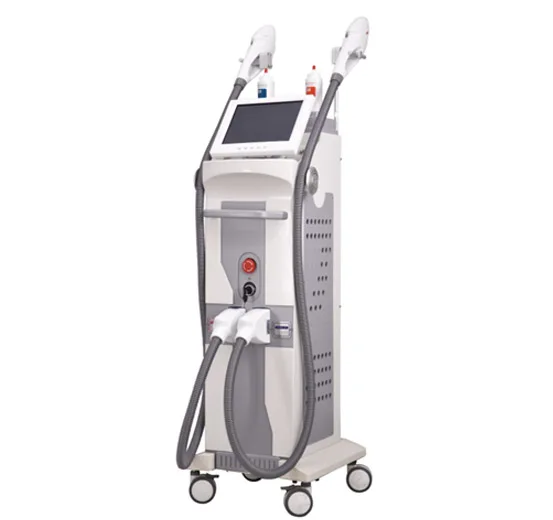
The Pmise MF-05 is an intense pulsed light machine with a bipolar radiofrequency channel in the same handpiece, which is all the E-Light label means. Filtered flashlamp light does the colour-selective work. RF adds heat that ignores colour.
Who buys one? Clinics that can't justify a box per indication, and distributors wanting one demo unit that answers what a salon owner asks. Output is broadband light filtered to 530-1200 nm at 10-45 J/cm2, with RF at 1 MHz and up to 100 W. That makes it an e light ipl rf machine, not a plain flashlamp.
Utilisation is where it earns its keep: hair reduction pays the lease, photofacials fill the quiet hours. Written for equipment buyers, not as medical advice.
How it works
A laser emits one wavelength, coherent, aimed at a single chromophore. A xenon flashlamp emits a broad incoherent spectrum. Both obey the rule Anderson and Parrish published in Science in 1983: pick a wavelength the target absorbs better than its neighbours, keep the pulse short, and the target cooks while they don't.
Glass steers broadband light. Our device manuals describe dual filtration rejecting everything below 400 nm, so no ultraviolet reaches skin. Over it goes the working cut-off: 530-1200 nm for rejuvenation, 585-1200 nm for vessels, 610-1200 nm for hair. Longer cut-off, deeper reach, less scatter. Our manuals go longer still on darker phototypes, which keeps surface melanin from swallowing energy meant deeper.
Pulse shape is where an OPT IPL machine separates itself. Fire a train of sub-pulses from an unregulated supply and peak energy sags pulse to pulse; our archive keeps both traces. Square-wave output holds every pulse at the same peak. Skip it and you're guessing: energy set for the fading tail burns the opener.
RF answers what light can't. Bipolar current at 1 MHz shuttles charged particles through tissue, so heat lands where impedance sends it, not where pigment sits. Poor melanin contrast is that case: light-brown hair, or a type IV complexion you've backed fluence off on. Our manuals put bipolar reach at roughly half the electrode gap.
Applications
- Hair reduction on legs, back and axillae, dark hair on light skin. Only anagen follicles respond, so IPL and laser hair removal protocols run as courses.
- Flat epidermal pigment: freckles, sun-induced lentigines, blotchy tone. An ipl photofacial with a short cut-off filter is the first pass for pigment and lentigo treatment.
- Facial vessels and diffuse redness. Our archive puts haemoglobin peaks at 418, 542 and 577 nm, all shallow and all contested by epidermal melanin. The 585 nm vascular cut-off opens just past that last peak on purpose, trading surface absorption for depth while haemoglobin keeps absorbing above it. Tan's dye-laser work measured it: 0.5 mm of vascular injury at 577 nm against 1.2 mm at 585 nm.
- Non-ablative skin rejuvenation, where sub-dermal heating raises fibroblast activity and texture improves over a course, not overnight.
- RF-only passes tighten jawline and neck; combined E-Light passes suit fine or light-brown hair, where fluence must come down.
Key advantages
- One console, several revenue lines. A clinic buying its first ipl beauty machine gets hair, pigment, vessels and tightening from one trolley.
- Square-wave OPT output means pulse ten lands like pulse one, so operators titrate against skin response, not guesswork.
- Filters swap in seconds. Going from opt machine hair removal to a photofacial is a filter change and a parameter recall.
- The sapphire contact-cooled window does three jobs our archive spells out: protects the epidermis, blunts pain, makes higher fluence survivable.
- The handpiece counts its own shots against a rated lamp life, so relamping lands on a schedule you can budget.
One Console for IPL Epilation and Photofacials
The MF-05 combines filtered IPL with bipolar RF in a single console, covering both IPL epilation and photofacial work. Clinics and distributors comparing ipl lasers can order this as a complete intense pulsed light hair removal system without adding separate platforms. It is also used for skin rejuvenation. As a factory-direct intense pulsed light machine for sale, the MF-05 is available with quotes from Pmise in Beijing.
Frequently asked questions
Which skin types can we treat safely?
Fitzpatrick I through IV is the comfortable ground. Our tables run to VI, but energy drops and pulse width stretches sharply as type climbs. Risk climbs with it. Test patches and conservative fluence stop being optional above type IV, and for type V or VI hair a longer-wavelength diode is better. Contraindications: pregnancy, recent sun exposure, active infection, isotretinoin within six months.
How many sessions should we quote a client?
Depends on the indication and on the client's hair and skin colour. The American Academy of Dermatology puts laser hair removal at two to six treatments spaced four to six weeks apart, with roughly 10 to 25 percent reduction after the first. Quote a course, promise nothing in one visit.
What does it cost to run?
The xenon flashlamp decides your economics. Our device manuals rate it at about 60,000 shots, and warn that hair removal, which runs the highest energies, can stop giving an ideal result near 30,000. Divide lamp price by rated life for a cost per shot; the handpiece counts shots. Relamping is a factory job. Change the cored water filter every two months, distilled water only.
What warranty, training and spare-part support comes with it?
Our device manuals set the standard terms: one year of free service from purchase on defects in materials or workmanship, then paid maintenance. Misuse, unauthorised repair and consumables sit outside it. Operators must pass training before use, and parameter tables by indication and Fitzpatrick type ship with the unit. Installation follows the manual. Order lamps and spares through us or your agent; ask for lead times and your market's certificate set in writing.
What can't the MF-05 do?
It won't clear tattoos, that's Q-switched territory, and it won't resurface an atrophic scar, which needs an ablative fractional laser. Grey, white and red hair carry no useful chromophore, so no filter or fluence will touch them. Melasma deserves caution, not enthusiasm. Undiagnosed pigmented lesions belong with a clinician first.
Evidence & further reading
Educational material for equipment selection and operator training. It is not medical advice, a treatment protocol or a promise of clinical outcome.
- Anderson RR, Parrish JA. Selective photothermolysis: precise microsurgery by selective absorption of pulsed radiation. Science 1983;220(4596):524-527
- Tan OT, Murray S, Kurban AK. Action spectrum of vascular specific injury using pulsed irradiation. J Invest Dermatol 1989;92(6):868-871
- American Academy of Dermatology. Laser hair removal: FAQs
- Lipp MB, Angra K, Wu DC, Goldman MP. Intense Pulsed Light: A Methodical Approach to Understanding Clinical Endpoints. J Drugs Dermatol 2021;20(2):203-207