Overview
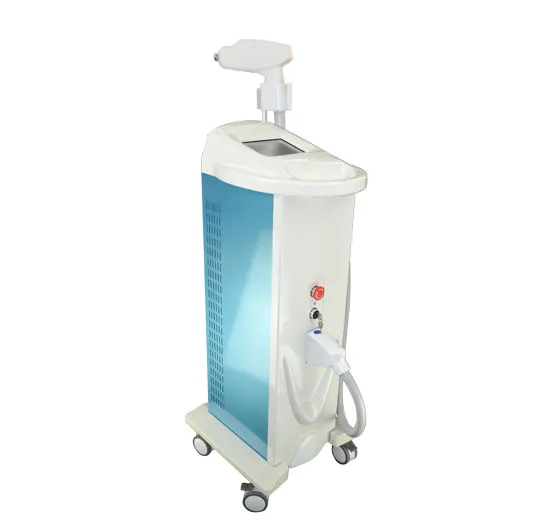
The Pmise DL-07 is an 808nm diode laser hair removal machine for clinics where epilation pays the rent. One wavelength, one job. It fires 808 +- 10 nm through a sapphire window up to 12x12 mm, at 2-80 J/cm2, with 10-100 ms pulses and a 1-10 Hz rate.
Who buys it? A clinic tired of running epilation on a broadband platform. Want photofacials too? The Pmise MF-05 E-Light IPL and RF platform is the honest answer, and our hair removal solutions guide sets them side by side.
Volume earns it floor space: legs, backs, underarms, bikini, Fitzpatrick I to IV. Educational material for equipment buyers, not medical advice.
How it works
Hair lasers rest on selective photothermolysis, the principle Anderson and Parrish published in Science in 1983. Pick a wavelength the target absorbs more than its surroundings. Pulse it long enough to cook that target, short enough to spare the rest.
So why 808nm? Our device manuals call 600 to 1200 nm the optical window into skin, the band StatPearls describes as selectively absorbed by melanin. Inside it, absorption trades against depth.
- 755 nm alexandrite. Melanin pulls hardest here, so StatPearls files it with lighter skin. Below 800 nm, our archive notes, light scatters in the epidermis.
- 808 nm diode. Past that line, reaching deeper pigment instead of scattering at the surface. StatPearls calls the diode safer in darker skin than the alexandrite.
- 1064 nm Nd:YAG. Deepest reach, less melanin absorption per StatPearls. The type V and VI tool, and it pays in grip on ordinary hair.
The DL-07 stays single-wavelength rather than stacking 755 and 1064 alongside. Pall and colleagues describe combined systems as a way to lift efficacy in darker skin. You pay for that range twice: more stacks to fail, more spare part paths.
Sapphire contact cooling is no comfort extra. Our engineering archive gives it three jobs: protect the epidermis, cut the pain of the shot, allow useful fluence at depth. No cold window, and the surface caps your dose.
- In-motion. Lower fluence, high rate, the tip gliding in sweeps while bulk heat builds. Our manuals say gel is not needed and quick movement keeps clients comfortable.
- Single-pass stacking. Higher fluence, low rate, one shot per spot. Coarse hair responds, but it wants a trained operator and a test patch.
Pulse width is never free. Our operation manual pairs it with rate: top rates exist only at the shortest durations, so a stretched pulse costs throughput. See our treatment solutions overview.
Applications
- Large-area body work on legs, back and chest, cleared in sweeps with a 12x12 mm spot at 10 Hz.
- Underarm and bikini reduction, the two areas that drive rebooking, at moderate fluence.
- Female facial hair on lip and chin, where hormones keep driving growth and a clinician should rule out endocrine causes.
- Ingrown hair and razor bumps on the male beard and neck, where thinning density, not clearance, is the goal.
- Maintenance passes months later; the American Academy of Dermatology notes regrown hair can be treated again.
Key advantages
- One wavelength, one purpose. No filter cassette, no second energy source. Three controls matter: power, pulse width, rate.
- Sapphire cooling at -4 C lets you run useful fluence instead of backing off to spare the surface. Clients notice comfort; dose is the gain.
- Running costs stay dull. Our manuals list the cooling-loop water filter as the routine consumable. No flashlamp, no cartridge.
- The handpiece is the capital item on the spare parts list, so diode stack life beats sticker price.
Frequently asked questions
Which skin types can I treat, and what changes above Fitzpatrick IV?
Specified for Fitzpatrick I to IV. Dark hair on light skin is the easy case: follicle-to-epidermis contrast does your safety work, and it collapses as skin darkens. Types V and VI fall outside that range, and Pmise warrants neither results nor safety there. Within I to IV our guidance moves one way as tone darkens: lower the energy, raise the repetition rate, patch test. Past IV is a clinician's call, not a supported indication.
How many sessions should I plan, and how far apart?
Only hair in anagen responds. Our manuals note melanocyte activity peaks then and stops in catagen. Cycles are never synchronised, so each pass catches a different share. The American Academy of Dermatology puts removal at six sessions or more. Our own guidance spaces them four to seven weeks apart.
What does it cost to run, and what about service?
Less than a lamp-based platform: no flashlamp, no cartridge. Our device manuals name the cooling-loop water filter as the routine consumable, and insist the chiller reaches temperature before firing. Control board, screen and handpiece are what get replaced. Ask any supplier, ours included, for shot life, price and warranty terms.
How much training does a new operator need?
More than a salon IPL, far less than a fractional device. Operators need Fitzpatrick assessment, patch testing, eye protection discipline and screening for photosensitising medication and recent tanning. Post-care in our manuals is short: no sun, no hot water, no sauna for a few days.
What can this machine not do?
It cannot treat white, grey or blond hair. No melanin, nothing to absorb the shot. Nor will it leave an area permanently bare. StatPearls is blunt about the wording: permanent hair reduction, not removal. The American Academy of Dermatology reports results holding on most of the body, but not on a woman's face.
Evidence & further reading
Educational material for equipment selection and operator training. It is not medical advice, a treatment protocol or a promise of clinical outcome.
- Anderson RR, Parrish JA. Selective photothermolysis: precise microsurgery by selective absorption of pulsed radiation. Science 1983;220(4596):524-527
- American Academy of Dermatology: Laser hair removal overview
- Laser Hair Removal. StatPearls, NCBI Bookshelf (wavelength selection by skin type; permanent hair reduction rather than removal)
- Pall A, et al. The Versatile Applications of Triple-Wavelength Diode Laser (810, 940 and 1060 nm) in Aesthetic Treatments, Follicular Disorders and Chronic Inflammatory Conditions in the Asian Population. Journal of Cosmetic Dermatology, 2025