Overview
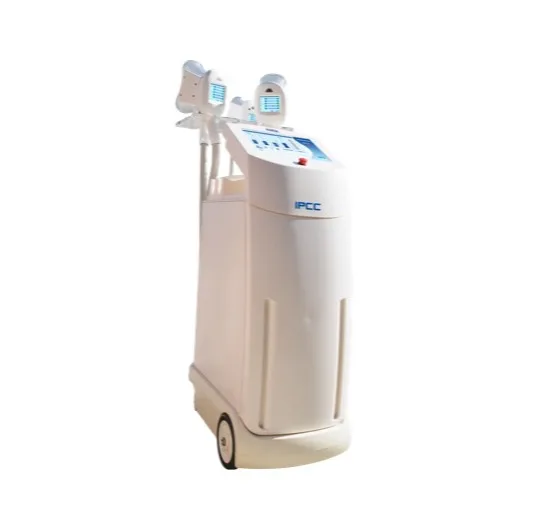
The Pmise CR-01 is a cryolipolysis fat freezing machine for clinics that sell shape, not scale weight. A vacuum applicator pulls a pinch of subcutaneous fat into a cooled cup and holds it there for a programmed cycle. Plate temperature and run length are set at the panel. Our device manuals put work time at 1 to 90 minutes in one-minute steps; one area usually books at 40 to 60 minutes. Suction adjusts. Thermal sensors and auto shut-off cut the cycle if the plate drifts.
Who buys it? Med spas already running a hair removal laser, fielding the same question about flanks and lower belly. Non-invasive body contouring sits beside the rest of the Pmise equipment range. Strap the cup, start the timer, prep the next room. Throughput matters more than the sticker price.
It earns its place on a stubborn bulge in someone near their target weight. Lower abdomen, flanks, thighs, a soft pocket under the chin. Point it at obesity and it fails in front of a paying client. Our body contouring solutions overview sets the wider context. Educational material for buyers, not medical advice.
How it works
Fat is the weak link in the cold. Lipid-rich adipocytes crystallise and take injury at temperatures that leave water-rich skin, nerve and vessel intact, the selectivity Manstein, Anderson and colleagues described when they published selective cryolysis in 2008. Hold it cold long enough and inflammation starts in the fat layer. Damaged cells die by adipocyte apoptosis over the days that follow.
Nothing shrinks on the table. Macrophages move in, clear the debris, and the lipid leaves through normal metabolism. Clearance runs over weeks. Book the review months out, not next Tuesday.
- Cleanse, gel, then an antifreeze membrane. Our device manuals make that membrane part of every placement. Skip it and you risk a cold burn.
- Seat the applicator and let the vacuum draw the bulge fully in. Our manuals rate suction flow at up to 140 litres per minute. A bulge that will not tent cannot be treated.
- Run the cycle, then massage the chilled flap to break up crystallised tissue.
- Send the client back to work. Redness, tingling and brief numbness are expected.
Buyers keep missing this. You clear a share of the cells in one pocket, so circumference changes while the scale mostly does not. Visceral fat sits behind the muscle wall, out of reach.
Applications
- Lower abdomen and the post-partum pouch, where skin recoil is still decent, worked as overlapping placements mapped before the first cycle.
- Flanks and love handles, where the 165 x 81 mm applicator face in our device manuals covers a roll in one seating, not three.
- Outer and inner thigh, where a curved profile follows the limb and the 128 x 57 mm face suits the tighter inner surface.
- Submental fullness, a small-applicator job, and only after a clinician rules out glandular tissue or plain laxity.
- Residual contour irregularity after liposuction, once the operating surgeon signs off.
Key advantages
- Applicator selection is the whole craft. Flat, curved and small heads plus adjustable suction match the cup to the tissue, not the tissue to one cup.
- Short consumable list. Gel and an antifreeze membrane per placement, and our device manuals record no filters fitted to the applicators.
- Modest siting. Semiconductor cooling on a distilled water loop, about 1.8 litres at first fill per our manuals, in a room held between 10°C and 30°C.
- Installation, operator training and spare parts run through our equipment service and support programme.
Frequently asked questions
Does skin type limit who we can treat?
Cold does not chase melanin the way light does, so Fitzpatrick type is not the gate it is on IPL or a diode laser. Tissue quality is. You want a pinchable bulge and decent skin recoil, since freezing fat under lax skin leaves the laxity more obvious. A lump nobody can explain? Clinician first.
Who should we turn away?
Anyone with a cold-related disorder. Cryoglobulinaemia, cold urticaria, paroxysmal cold haemoglobinuria and Raynaud phenomenon are listed as contraindications in cryolipolysis device labelling; the first three appear in Ingargiola and colleagues' 2015 review in Plastic and Reconstructive Surgery. Hernia at the site, skin infection, pregnancy and impaired sensation stop it too. Unsure? Clinician's call.
How many sessions, and when does the change show?
Plan a course of several sessions per area, weeks apart over the same spot, and book the review far enough out that clearance has happened. Results build gradually and vary between clients. Say so at the consultation and put it in writing. The clients who complain later were promised a fast number.
What does a cycle cost to run, and what support comes with the machine?
Power, gel and one antifreeze membrane at every placement. Our manuals put peak draw at 1400 W, so a normal clinic circuit carries it. Model the membrane cost, buy in volume, price it into the fee. The cooling loop takes distilled water only, changed roughly every 30 days under heavy use. Get warranty terms in writing, training included.
What are the real risks, and what can this machine not do?
Expect redness, swelling, tingling and temporary numbness. One rare reaction deserves saying out loud: paradoxical adipose hyperplasia, reported by Jalian and colleagues in JAMA Dermatology in 2014, where treated fat turns firmer and larger months later. It does not resolve on its own. Disclose it. Off the list: weight loss, visceral fat, skin tightening.
Evidence & further reading
Educational material for equipment selection and operator training. It is not medical advice, a treatment protocol or a promise of clinical outcome.
- Manstein D, Laubach H, Watanabe K, Farinelli W, Zurakowski D, Anderson RR. Selective cryolysis: a novel method of non-invasive fat removal. Lasers in Surgery and Medicine, 2008;40(9):595-604
- Ingargiola MJ, et al. Cryolipolysis for Fat Reduction and Body Contouring: Safety and Efficacy of Current Treatment Paradigms. Plastic and Reconstructive Surgery, 2015;135(6):1581-1590
- Jalian HR, Avram MM, Garibyan L, Mihm MC, Anderson RR. Paradoxical adipose hyperplasia after cryolipolysis. JAMA Dermatol. 2014;150(3):317-319
- Cryolipolysis: patient selection and special considerations (review, PubMed Central) - general background on candidate selection and cold-sensitive conditions
- Ingargiola MJ, Motakef S, Chung MT, Vasconez HC, Sasaki GH. Cryolipolysis: patient selection and special considerations