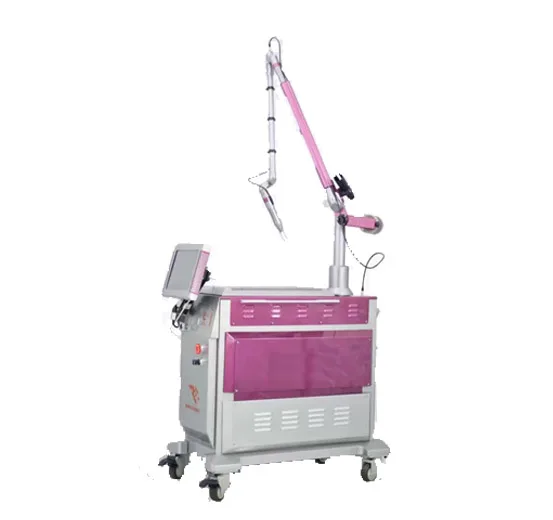
Overview
The Pmise QE-01 is a Q-switch laser machine built on an electro-optically switched Nd:YAG rod. Two jobs fill its day: tattoo removal laser work, and pigmented lesions creams never reach.
Who buys one? Dermatology clinics with a doctor on staff, medical spas under physician supervision, and distributors anchoring a pigment removal treatment line. It rewards a trained operator and punishes a careless one.
Depth is where it earns floor space. The 1064 nm beam reaches dermal targets broadband light can't touch. Know the boundary: no hair removal, no tightening, no vascular work. For diffuse sun damage the Pmise MF-05 E-Light system is faster, and most clinics own both.
How it works
Q-switching is a shutter trick. Hold the cavity shut while the rod soaks up flashlamp energy, then open an electro-optic gate in nanoseconds. Everything stored leaves as one spike, and pulse shape repeats shot after shot.
This matters more than the sticker price. A pigment granule is tiny and sheds heat fast. Fire a pulse shorter than its cooling time and the energy has nowhere to go: the particle cracks. That's the photoacoustic effect, and it's why a q switched nd yag laser fractures pigment instead of cooking skin. Anderson and Parrish set out the rule in Science, 1983.
- 1064 nm goes deepest and is weakly absorbed by epidermal melanin: dermal pigment, plus black, blue and green-blue ink.
- 532 nm is 1064 nm doubled through a KTP crystal. Shallow, strongly absorbed, so it takes red, warm shades and epidermal spots.
- Both together cover coffee and brown tones, as our device manuals split the colours.
Fragmentation is half the job. Macrophages haul debris out through the lymphatics over weeks, so spacing is biology, not scheduling. Our archive drills the rest: handpiece perpendicular, one third overlap, low-energy test shots first.
Laser toning is the second mode. Very low fluence, wide spot, repeated gentle passes at diffuse melanin. Melasma is where clinics reach for it and where the risk sits. A 2022 systematic review reports frequent recurrence once treatment stops, and links mottled hypopigmentation to heavy dosing. Our archive calls a 0.5 to 1 cm2 trial patch necessary first.
Applications
- Tattoo removal in black, blue-black and green-blue ink at 1064 nm, 532 nm for red and warm shades.
- Dermal melanocytic lesions, nevus of Ota and zygomatic macules, where pigment sits below broadband light's reach.
- Epidermal pigment, solar lentigines and cafe-au-lait macules: 532 nm on lighter skin, 1064 nm as skin darkens.
- Low-fluence toning for melasma, wide spot and a light hand, only after a clinician confirms the diagnosis.
- Carbon toning, lotion worked into the pores then swept at 1064 nm, inside a skin rejuvenation programme.
- Cosmetic eyeliner and eyebrow correction, demanding rigorous eye shielding and a practised hand.
Key advantages
- Electro-optic switching holds a tighter, more repeatable pulse than a passive switch, and repeatability makes an endpoint teachable.
- Two wavelengths from one cavity. Red ink and epidermal spots won't send you shopping for a second machine.
- Fluence headroom to 14 J/cm2 at 1064 nm and 6 J/cm2 at 532 nm, so dense targets don't push it to its ceiling.
- No disposable tips, no cartridges, nothing chipped locking you to one supplier. Flashlamp, cooling water and treatment tip are what wear, all stocked.
- A defined after-sales position, not a shrug: twelve months on defects, installation and operator training at handover, remote support afterwards.
Frequently asked questions
Which skin types can be treated, and who should be excluded?
Every Fitzpatrick type, though the margin narrows as skin darkens. Competing epidermal melanin raises post-inflammatory hyperpigmentation risk. On types IV to VI, stay at 1064 nm, widen the spot, drop fluence. Our device manuals exclude pregnancy, pacemakers and broken skin. Diagnosis comes first: melanoma can mimic benign pigment, so a clinician sees the lesion first.
How many sessions, and how far apart?
Per our device manuals, cafe-au-lait macules take 6 to 8 sessions at 45 to 60 day intervals; nevus of Ota also 6 to 8, at 60 to 90 days. Tattoos differ: an NHS laser centre quotes 4 to 6 sessions for amateur ink, 10 to 12 for professional work, 8 weeks apart. Ink plateaus, and white and some greens may never clear.
What does it cost to run, and how do you supply the flashlamp?
Per-shot cost is low; nothing disposable touches the patient. Real line items: flashlamp, purified cooling water, eyewear, optics cleaning. Our archive puts flashlamp life for this class of Q-switched Nd:YAG near 1000 hours, after which output drops. Cooling water runs a two-month cycle, and spare lamps and handpieces ship on request.
What do installation, training and after-sales cover?
Commissioning follows the manual: articulated arm, treating tip, power supply, foot pedal, interlock stub. Training covers wavelength choice, tissue endpoints, eye safety and aftercare; our archive is blunt that no untrained hand should touch an intense-light device. Remote support continues after handover. Our standard position is twelve months' free repair for material or workmanship defects, with misuse and unauthorised disassembly outside it.
What documentation can I get for my market, and what happens next?
Documentation is compiled per territory on request, with the operator manual and technical sheet. We publish no certification claim for the QE-01 here, so confirm what your regulator demands before importing. Lead time, warranty length and payment terms are quoted per order. Clinic owners, request a quote. Distributors, request the market documentation pack. Educational material for buyers, not medical advice.
Evidence & further reading
Educational material for equipment selection and operator training. It is not medical advice, a treatment protocol or a promise of clinical outcome.
- Anderson RR, Parrish JA. Selective photothermolysis: precise microsurgery by selective absorption of pulsed radiation. Science. 1983;220(4596):524-527
- Lee YS et al. The Low-Fluence Q-Switched Nd:YAG Laser Treatment for Melasma: A Systematic Review. Medicina (Kaunas), 2022
- Bristol Laser Centre, North Bristol NHS Trust. Laser treatments: tattoos (session numbers and 8-week spacing)