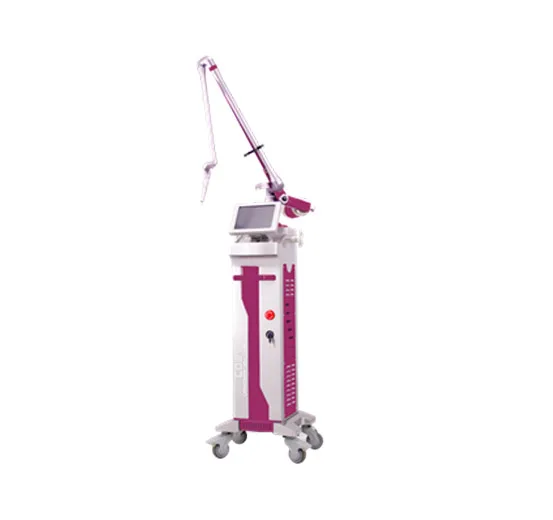
Overview
The Pmise CF-01 is a 10600 nm CO2 laser with three output modes, a 7-joint articulated arm and a scanning handpiece. Pulse energy runs 2 to 200 mJ. Spot sizes step through 0.12, 0.3, 1 and 3 mm, so one machine covers a fine fractional grid and a broad ablative pass.
Buyers are clinics that already own a pigment laser and keep referring texture cases out the door. Acne scarring is the classic gap. A CO2 fractional laser machine is rarely a room's first laser. It's the one that lets you quote on scars instead of apologising for them.
Ablative means a wound. Your patient goes home red, swollen and crusting, and needs to hear that before they book. Run it well and the CF-01 anchors a paid scar resurfacing programme plus much of your skin rejuvenation menu. Run it casually and you'll spend months managing complications. This is educational material for equipment buyers, not medical advice.
How it works
At 10600 nm the target is water, not melanin or haemoglobin. Skin is mostly water, so the beam heats whatever tissue it lands on. That's why this machine resurfaces rather than clears pigment, and why pigment cases still belong on a Q-switched Nd:YAG such as the Pmise QE-01.
Temperature sorts the outcome. Our device manuals put collagen contraction near 65C, denaturation above roughly 75C, vaporisation past about 300C. Ultrapulse output crosses that threshold in microseconds, so tissue leaves as vapour before heat spreads sideways. A thin coagulated rim stays behind. You want that rim; it stops bleeding and drives remodelling. You don't want it thick. Our archive is blunt that healing degrades once coagulation passes 200 microns.
Fractional mode is the scanner drilling narrow columns and skipping everything between them. Those columns are the microthermal zones. The spared bridges between them are the reservoir keratinocytes migrate from, which is why fractional resurfacing heals in days rather than weeks. Manstein and colleagues named the concept in 2004. Inside the handpiece, X and Y mirrors steer the beam through an F-theta lens, firing spots in random order so each cools.
- Energy per microspot sets depth, and depth reaches the dermal collagen a bound-down scar lives in.
- Density sets how much surface you removed. Downtime and pigment risk track density harder than depth.
- Scan patterns shape the pass. Square blocks tile a cheek; round, rhombus, triangle and line patterns fit a nose, lip or linear scar.
Applications
- Atrophic acne scars in fractional mode, once the acne is quiet and the scar mature; our archive wants a low-energy test area first.
- Surgical and traumatic scars, with the pattern matched to the scar's shape rather than the region around it.
- Photoageing and rhytides around eyes, mouth and forehead, where our archive favours treating a whole cosmetic unit over patchy spot work.
- Benign lesions such as syringoma, sebaceous hyperplasia and rhinophyma, using continuous or ultrapulse output with no bleeding field.
- Gynaecology, ENT and general surgery appear in our archive for this platform, but each needs its own handpiece and local regulatory clearance.
Key advantages
- RF-excited tube, not glass. Our engineering archive compares them: RF output holds steady with an even focal spot size and density, glass tube energy falls away from the start, and RF tube life runs to tens of thousands of hours against hundreds.
- Ultrapulse, continuous and fractional in one chassis, so a single purchase covers resurfacing, scar work and small lesion surgery.
- Energy across 2 to 200 mJ. Drop right down for a cautious first pass, climb for dense scar tissue.
- Four spot sizes, 0.12 to 3 mm. Small spots go deeper, large spots cover ground.
- Standard silica fibre can't carry 10600 nm, so the 7-joint mirror arm is a requirement, not styling.
Frequently asked questions
Can you treat darker skin types with it?
Cautiously, and not always. Our archive flags Fitzpatrick III and above as higher risk of pigment change after ultrapulse CO2, and asks for a low-energy test area first. Low density, strict sun avoidance, topical pigment control once hyperpigmentation appears rather than pre-loaded. The call is the clinician's.
How many sessions should we plan, and how far apart?
Plan a course, not a visit. Deep scars need repeated passes, and our archive puts a second full resurfacing six to twelve months after the first. The American Academy of Dermatology warns that laser scar results take months, and that one treatment is often not enough.
What does it cost to run, and what downtime do we quote?
No disposable tips, the running-cost advantage over needle devices. Budget for goggles, eye shields, smoke evacuation, anaesthetic and dressings. The tube is the big consumable, and RF-excited tube life runs to tens of thousands of hours. On downtime, the American Academy of Dermatology tells patients to stay home five to seven days.
Who may operate it, and what training comes with it?
It's a Class 4 laser and belongs in trained clinical hands. Rules on who may fire an ablative device differ by country, so confirm yours before ordering. Pmise supplies installation, operator training and the manual. Get warranty scope and parts lead time into the contract.
What can it not do?
It won't remove a tattoo or clear melasma, because 10600 nm chases water and not pigment. It won't lift a jowl. Our archive contraindicates recent isotretinoin, keloid tendency, active herpes or skin infection, immunosuppression, pregnancy and poorly controlled diabetes. The American Academy of Dermatology counts pain, infection and scarring among the risks patients should be briefed on before laser treatment.
Evidence & further reading
Educational material for equipment selection and operator training. It is not medical advice, a treatment protocol or a promise of clinical outcome.
- Manstein D, Herron GS, Sink RK, Tanner H, Anderson RR. Fractional photothermolysis: a new concept for cutaneous remodeling using microscopic patterns of thermal injury. Lasers in Surgery and Medicine 2004;34(5):426-38
- American Academy of Dermatology, 10 things to know before having laser treatment for your scar
- American Academy of Dermatology, Many ways to firm sagging skin (ablative laser resurfacing downtime)