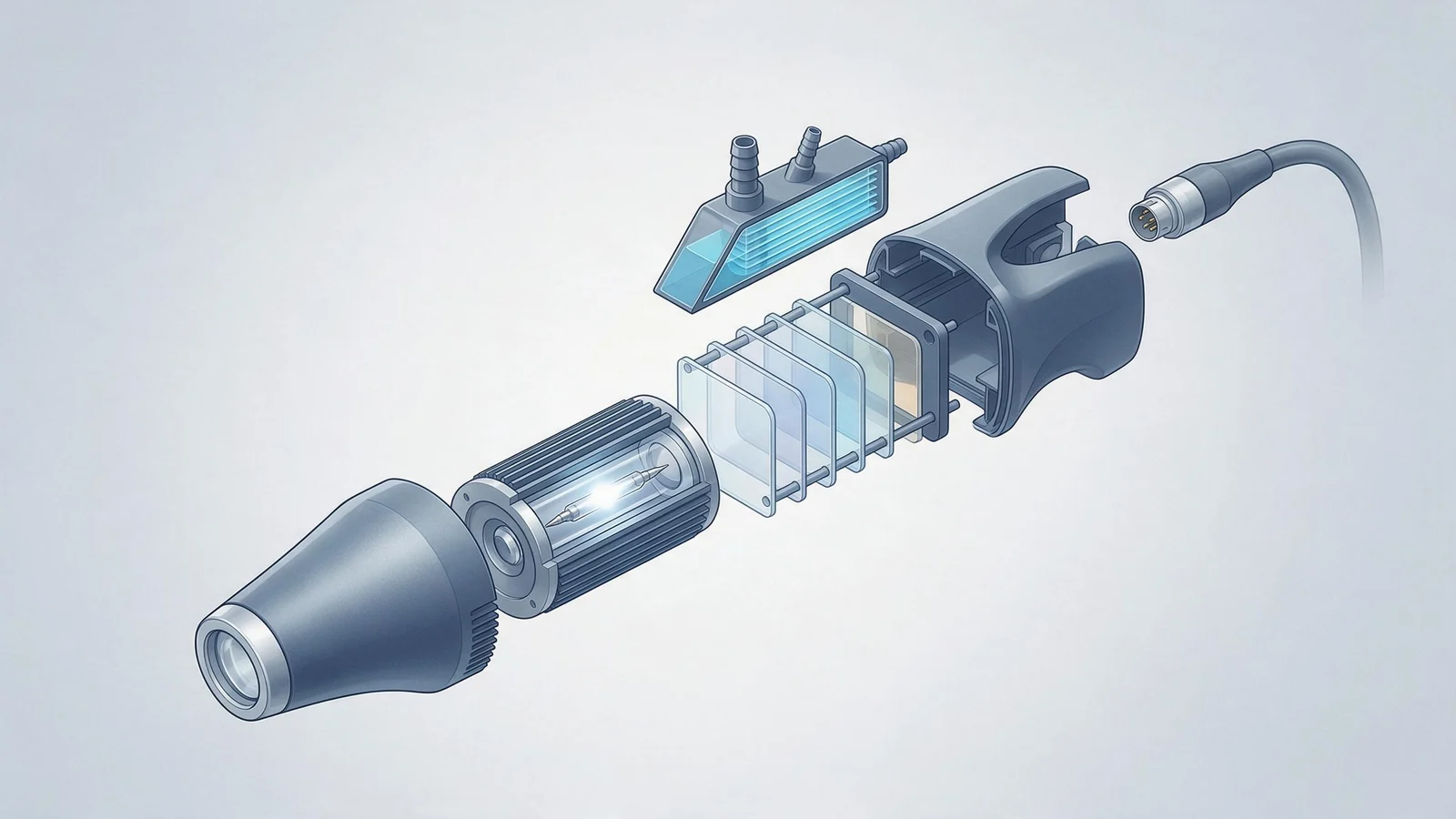
The Flashlamp: The Heart and the Wear Part
Your IPL runs on a xenon flashlamp. It isn't a laser tube but a glass envelope filled with xenon gas, and a high-voltage pulse ionizes the gas to emit light across a broad spectrum of roughly 400 nm to 1200 nm. That wide emission sets IPL apart from lasers. A laser delivers a single wavelength, a flashlamp provides a band you'll filter later.
The flashlamp won't last forever. Manufacturers rate it in pulses, often 50,000 to 100,000 shots, but don't take that number as gospel. It assumes moderate energy and no overheating. Running at max fluence all day shortens lamp life. Ask the real questions: what's the lamp replacement cost, and can you change it in the field? Some handpieces have integrated lamps, so you'll ship the whole piece back. That downtime hurts.
You can check rated pulses, lamp replacement cost, and serviceability on a spec sheet. What you won't see is how the lamp degrades. Output drops slowly, so at shot 80,000, the machine might still fire but deliver 20% less energy. Calibration fixes that, but only if the device has an internal energy monitor. Does yours?
Cut-On Filters: Where the Magic Is Decided
The flashlamp's raw output includes ultraviolet and infrared you don't want on skin. Cut-on filters, which are colored glass or coated optics placed in the beam path, absorb or reflect wavelengths below a certain threshold, letting only longer wavelengths through. A 560 nm filter blocks everything below 560 nm. That's why you'll see IPL devices with interchangeable filter tips: 480 nm, 560 nm, 640 nm, 690 nm, each targeting different chromophores, so shorter wavelengths hit superficial pigment while longer wavelengths penetrate deeper for hair follicles or vessels.
But filters aren't perfect. They have a slope, not a cliff, so a filter labeled 560 nm will still leak a small percentage of shorter light. Over time, the filter coating can degrade if the device runs hot or the glass gets scratched. A scratched filter can pass more UV than intended—that's a safety issue. Ask for the filter's spectral transmission curve, a graph of wavelength versus percentage transmitted. If the vendor won't share it, that's a red flag.
What can you check? Which filters are included, whether they're user-changeable, and the transmission curve. What hides? Filter aging and UV leakage over time. Some manufacturers publish the initial curve only. Ask for data after 10,000 pulses.
Pulse Structure: Why It's Not a Square Wave
It's not a simple on-off square. An IPL pulse is a complex burst with a fast rise, a plateau, and a decay, often broken into sub-pulses separated by milliseconds of off time. This shaping matters clinically. Because one long pulse can overheat the epidermis—break it into two or three shorter pulses with pauses, and the skin cools between bursts while the target (like a hair follicle) retains heat since it's larger and has slower thermal relaxation. That's pulse train or multi-pulse technology.
Spec sheets list pulse duration in milliseconds and pulse delay in milliseconds. Some devices let you adjust the number of sub-pulses. More adjustability helps with different skin types, since darker skin needs longer wavelengths and longer delays to avoid burning. A device with only fixed pulse parameters? It'll work for a narrow patient range.
You can check pulse duration range, pulse delay range, and whether sub-pulses are user-adjustable. But what's hidden is the actual temporal shape of the pulse. A cheap power supply might produce a sloppy pulse with a slow fall, depositing energy after the intended window. That leads to inconsistent results.
Cooling: The Unsung Safety System
Contact cooling isn't a luxury. It's what lets you treat darker skin without burning the surface. Most professional IPL devices have a sapphire or quartz cooling tip that sits against the skin, chilled to around 0-5°C by a thermoelectric cooler or a water circuit. The cold constricts superficial blood vessels and numbs the epidermis, allowing more energy to reach the target below. Without contact cooling, you're stuck at lower fluences—more sessions, less effective treatment. There are two cooling designs: integrated and add-on. Integrated cooling means the handpiece tip stays cooled during operation, while add-on cooling might be a cold air blower or a separate gel. Integrated is better for patient comfort and consistency. Ask about the cooling temperature range and whether it's adjustable, since some devices let you set the tip temperature for different skin types. Also ask how cooling is maintained during a long session. A small thermoelectric cooler might struggle on a busy day, but a water-cooled system with a chiller is more robust. What can you check? Cooling method, tip temperature range, and whether cooling is active during the pulse. What's hidden? Cooling recovery time between pulses. If the tip warms up after a few shots and takes minutes to cool, your throughput drops.Power Supply and Duty Cycle: The Engine Room
The power supply charges capacitors and fires the flashlamp. Its quality determines pulse stability and repeatability, because a weak supply can't deliver consistent energy shot after shot at high repetition rates. Duty cycle matters. It's the percentage of time the device can operate at maximum power without overheating. Many IPL devices are rated for a certain number of pulses per minute at a given fluence, so exceed that and the device may shut down or the lamp may fail early.
Ask about the maximum repetition rate and recommended duty cycle for continuous use. A clinic doing back-to-back full-body hair removal needs a machine that fires every 2-3 seconds for an hour. A portable unit might only manage one shot every 5 seconds. That difference shows up in your daily schedule.
What can you check? Repetition rate, max fluence at that rate, and cooling system for the power supply. What's hidden? Actual voltage stability. Cheap power supplies have voltage sag, meaning the first pulse after a pause is stronger than subsequent pulses. Dangerous for the patient, frustrating for the operator.
The Handpiece and Its Hidden Counter
You hold the handpiece. It contains the flashlamp, the filter, the cooling tip, and often a trigger button, but inside there's a small electronic counter that records every pulse. That counter's your best friend when buying a used device, telling you how many shots the lamp has fired and whether the seller is honest about usage. Some devices display the count on the screen. Others require a service tool to read. If you can't get the count, walk away.
Handpieces come in different sizes. Spot size determines treatment speed: a larger spot covers more area but may have lower fluence because the energy is spread out, while a smaller spot delivers higher fluence but takes longer. For hair removal on legs, you'll want a large spot. For facial telangiectasias, a smaller spot gives precision. Many devices offer interchangeable handpieces or adjustable spot sizes, so consider your primary treatments before choosing.
What can you check? Spot size options, handpiece weight (a heavy handpiece causes operator fatigue), and whether the counter is accessible. What's hidden? The actual optical quality of the light guide. A poorly polished guide loses energy at the edges, creating hot spots. Ask for a beam profile test if possible.
Professional Platforms vs. Portable Units vs. Home Appliances
IPL devices aren't all equal. The market splits into three distinct tiers: professional platforms, portable units, and home appliances. Professional platforms are big machines with articulated arms, large power supplies, and multiple handpieces, and they cost tens of thousands of dollars. But they offer high fluence, fast repetition rates, and robust cooling, built for daily use in a busy clinic. Portable units are smaller, often tabletop, with integrated handpieces. They cost less and are easier to move, but they sacrifice some power and speed, so they suit smaller practices or those starting out. Home appliances are the handheld devices sold for personal use. They have low fluence, small spot sizes, and safety interlocks to prevent misuse. They're not suitable for professional use, and no clinic should rely on them.
When comparing categories, look at fluence. Professional devices typically offer 10-50 J/cm², while home devices might top out at 5-7 J/cm². That's a huge difference in efficacy. Also check the repetition rate and cooling capacity. A portable unit may have professional-level fluence but a low duty cycle, meaning it overheats after 20 minutes. That's fine for occasional use but not for a full day of treatments.
You can see the difference in our MF-05 multifunction E-Light, which combines IPL with RF for professional skin rejuvenation and hair removal. It's a platform device with multiple filters and high repetition rates. Compare that to any home appliance and the gap is obvious.
What to Ask Before You Buy
What's the flashlamp rated life in pulses, and what's the replacement cost including labor? You'll also want to know if you can change the lamp in the field, or does the handpiece need to be sent back? Which cut-on filters are included, and can you see the spectral transmission curves? Ask about pulse duration range and sub-pulse adjustment. What's the maximum fluence at the largest spot size, and what's the repetition rate? Don't forget cooling. What's the tip temperature range? What's the recommended duty cycle for continuous use? Can you access the shot counter, and what's the current count on the demo unit? What's the warranty period, and does it cover the flashlamp? What training and support are included? These questions separate the serious equipment from the toys. A vendor who can't answer them isn't worth your money.FAQ: IPL Devices
What does IPL stand for?
IPL stands for intense pulsed light. It's a technology that uses a xenon flashlamp to produce broad-spectrum light pulses, unlike lasers which emit a single wavelength. The light is filtered to select the therapeutic range for various skin treatments.
How does an IPL device differ from a laser?
A laser emits one specific wavelength, while an IPL device emits a broad band of wavelengths, typically 400-1200 nm, filtered to the desired range. That makes IPL more versatile for treating different targets, but less selective than a laser. Lasers can be more precise for specific chromophores. IPL covers a wider range of indications with one device.
What skin conditions can an IPL device treat?
You'll use IPL for hair removal, vascular lesions like spider veins and rosacea, pigmented lesions like age spots and freckles, and overall skin rejuvenation. It works by targeting melanin in hair and pigment, and hemoglobin in blood vessels. For skin rejuvenation, it stimulates collagen production. See our skin rejuvenation solutions for more details on clinical protocols.
Is IPL safe for all skin types?
IPL can be used on most skin types. Caution is needed for darker skin tones (Fitzpatrick IV-VI) because the melanin in the epidermis absorbs light and can cause burns or post-inflammatory hyperpigmentation. Modern devices with longer wavelengths, longer pulse durations, and effective contact cooling can treat darker skin safely. Proper training and test spots are essential. Always follow the manufacturer's guidelines and consider referral for very dark skin.
How often should an IPL device be serviced?
Service intervals depend on usage, but a professional device should be checked at least annually. The flashlamp output should be calibrated, and the cooling system inspected. Many manufacturers recommend replacing the lamp after a certain number of pulses. Calibration can extend its life. Keep a log of shots and any issues to track performance over time.
Evidence & further reading
Educational material for equipment selection and operator training. It is not medical advice, a treatment protocol or a promise of clinical outcome.