IPL is not a laser, and that's the whole buying decision
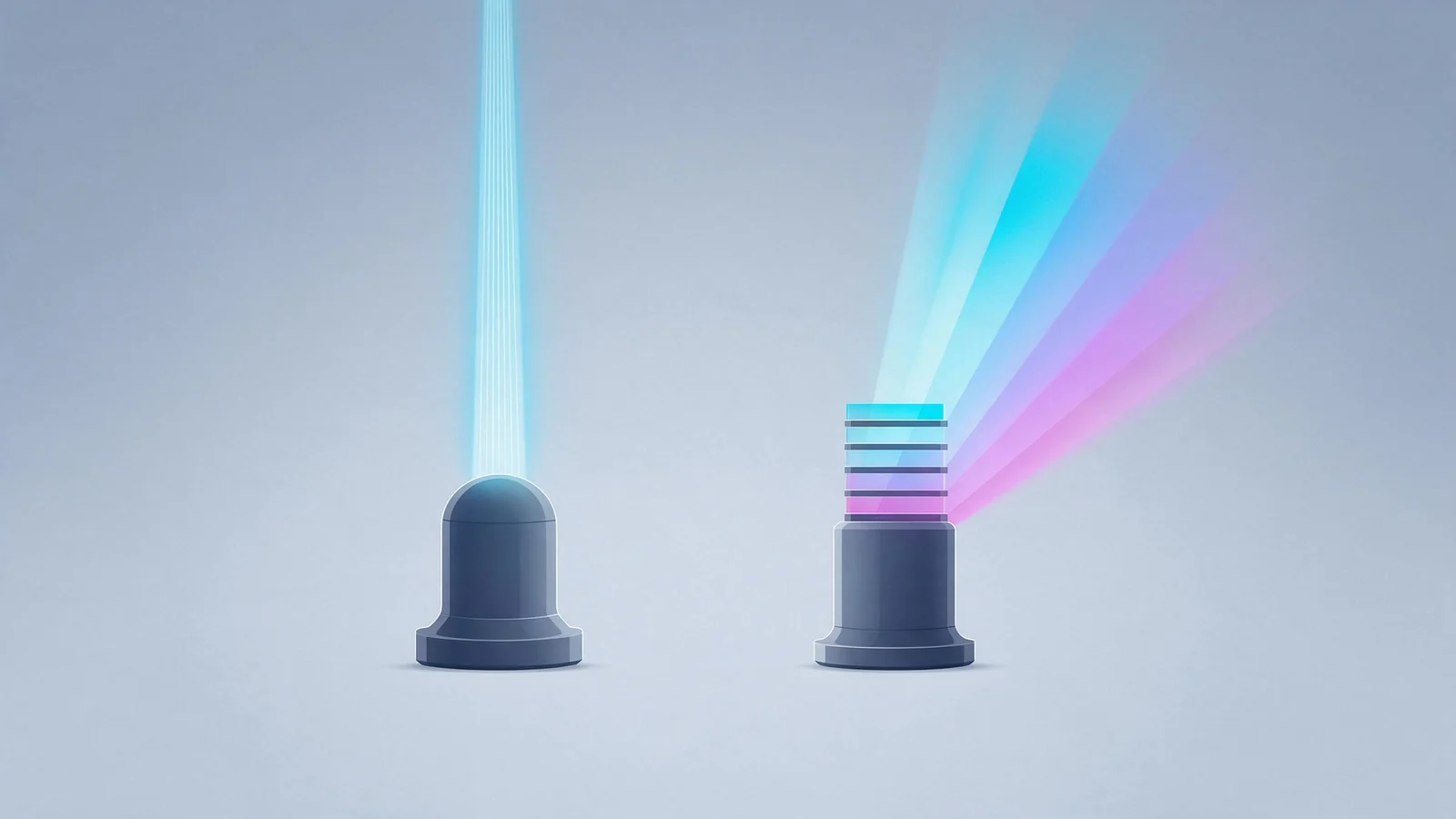
A laser emits one coherent wavelength. IPL emits a broad polychromatic band that gets shaped by cut-on filters. That difference decides what you can treat, on whom, and how safely. The FDA cleared the very first IPL device in 1995, and the technology hasn't stopped splitting into subcategories since.
When a clinic owner types "IPL laser for hair removal" they usually mean one of three things. They mean a true broadband IPL handpiece. They mean a diode laser and don't know the distinction. Or they mean a combination platform like our MF-05 E-Light system, which pairs IPL with RF. The buying question is not which phrase is correct. It's which chromophore problem you actually have.
Melanin in the hair shaft and bulb is the target. Coarse dark hair absorbs heavily. Fine light hair barely absorbs at all. A diode laser at 810 nm is single-minded about that melanin. IPL is a flexible platform because the broadband light can be filtered down to different wavelength ranges for different skin types and hair colors. That flexibility is real. So is the risk of burning darker skin if the operator doesn't adjust the cut-on filter.
Quotable: IPL devices use flashlamps and bandpass filters to generate pulsed light with varying wavelengths, durations, and fluences. That is the formal definition. A laser has one wavelength, one pulse profile, one job. An IPL has a wavelength range, adjustable pulse width, and multiple jobs. If your clinic sees only thick dark hair on Fitzpatrick III to V skin, a diode is the safer single-purpose buy. If you need to treat a mixed caseload, the IPL platform earns its place.
The wavelength range does the work, not the marketing name
Broadband light matters because it lets you move the cut-on filter. Lower filters, around 500 to 600 nm, target finer hairs and lighter skin but raise the risk of post-inflammatory hyperpigmentation. Higher filters, 690 nm and above, protect epidermal melanin, which is exactly what you need for Fitzpatrick IV or V. The same IPL machine can behave like three different devices depending on the filter you insert. That's the buying implication. Two platforms with the same headline spec can behave very differently because their filter sets, pulse duration control, and cooling systems are not the same.
Our engineering archive notes that the RF device offers a cooling temperature range of -2°C to 0°C. That's a contact cooling figure from a different modality, but it shows how tightly cooling specs run on modern energy platforms. For IPL, the cooling system is not an accessory. It's the difference between a tolerable treatment and an abandoned one on a patient with olive skin. Look for a machine with sapphire contact cooling or a thermoelectrically chilled tip, not just a fan.
And the "IPL laser" phrase? It persists because the two technologies get marketed together, and because some regulators file them under the same product code. The FDA cleared at least one IPL and diode combination machine under a single 510(k), which tells you how blurred the line is at the point of sale. But the physics doesn't blur. One coherent wavelength versus a polychromatic band.
Diode versus IPL on real patients
The two wavelengths which can safely be used for laser hair reduction on darker skin types are the diode (810 nm) and Nd:YAG (1064 nm). That's a clinical finding, not a brochure claim. For Indian skin with dark hairs, the diode laser was the ideal laser affecting coarse thick hairs, whereas IPL was not suitable for dark-skinned Indians as it targeted only fine hairs. Another study found the 810 nm diode laser safe and effective in the reduction of dark, coarse terminal hairs in Fitzpatrick skin types III-V. Those are the boundaries.
IPL can do hair removal. It's cleared for it. The SHASER IPL Hair Removal System, an over-the-counter device, showed an average hair reduction of 37% at 3 months and 48% at 6 months after final treatment in a clinical trial of 111 test sites. So the modality works. But the diode is more selective for the melanin in coarse hair, which means faster results on that patient profile with fewer sessions. Our DL-07 diode laser is built for exactly that caseload: a single wavelength, high fluence, no filter decisions.
If your clinic treats a lot of fine vellus hair, IPL with a lower wavelength filter is arguably better because the broader band can heat a wider range of hair shaft sizes. But that same broad band is riskier on darker skin. The FDA review on home IPL devices said it plainly: home-pulsed IPL devices are regarded as a safe therapeutic option for laser hair reduction, however, darker skinned patients should use low-fluence IPL. And a separate report on IPL home devices stated that the devices are not as safe as initially reported and when using professional laser systems, there is a thin line between achieving the appropriate outcome and the manifestation of complications. That thin line is your clinical responsibility.
What else the platform can do, and why that matters for ROI
A pure diode does one thing. An IPL platform can treat hair, pigmented lesions, vascular lesions, and even do skin rejuvenation. That's why combination machines exist. The combined IPL (680-980 nm)/RF light source with contact cooling is a safe and effective method of long-term hair reduction in patients of diversified skin types and varied hair colors, according to an 18-month follow-up. The RF component isn't just a gimmick: it pre-heats the tissue and lowers the optical fluence needed, which expands the safe skin type range.
Our hair removal solutions page breaks down the trade-offs for a clinic deciding between modalities. The MF-05 E-Light is a multifunction platform: IPL plus RF plus skin cooling for mixed practice. The DL-07 is a single-minded diode. The right choice depends on how many treatment types you actually book in a month.
Checklist for buyers:
- Filter range: does the IPL handpiece offer cut-on filters from at least 500 nm to 750 nm? If not, you cannot safely treat darker skin.
- Cooling: is the contact cooling actively chilled, and what's the lowest temperature spec? Passive cooling is not enough for high fluence.
- Pulse control: can you adjust pulse duration independently from fluence? This is the single biggest safety dial on an IPL.
- Replaceable lamp: what's the rated shot count, and what does a replacement lamp cost? That's your consumable overhead.
- Service record: ask for the manufacturer's training manual before you buy. If it's thin, the machine is a risk.
Regulatory clears and what they don't tell you
The FDA has cleared multiple IPL devices for hair removal under product code ONF, and at least two ice-cooling IPL devices under product code OHT. Those clearances mean the device is substantially equivalent to a predicate. They do not mean it's the right machine for your patient mix. A 510(k) clearance for a home-use device like the SHASER is different from a professional system. One has a low fluence cap. The other can burn.
Look up the 510(k) summary before you buy. It will tell you the intended use, the wavelengths, the fluence range if you're lucky, and the clinical data submitted. The FDA cleared an IPL plus diode combination machine under a single 510(k), which is why the "IPL laser" phrase won't die. The regulator itself sometimes treats them as one category. But your treatment room doesn't.
FAQ
Is IPL a laser?
No. A laser emits one coherent wavelength. IPL emits a broad polychromatic band, typically 400 to 1200 nm before filtering. The FDA's own definition confirms IPL devices use flashlamps and bandpass filters. The phrase "IPL laser" is a misnomer, but it's so common that equipment buyers use it to mean any light-based hair removal device, including diode lasers.
Which is better for dark skin: IPL or diode?
For Fitzpatrick IV to VI, the diode laser at 810 nm is safer because its single wavelength penetrates deeper with less epidermal melanin absorption. Clinical studies specifically state that the diode and Nd:YAG are the only two wavelengths safe for darker skin types. IPL can be used on dark skin only with high cut-on filters and low fluence, and even then the risk of post-inflammatory hyperpigmentation is real.
Does IPL work on fine or light hair?
IPL can target fine hair better than a diode if you use a lower wavelength filter, but the results are slower and less predictable. The SHASER trial showed 37% hair reduction at 3 months, which is meaningful but modest. For coarse dark hair, a diode laser will get to the same endpoint faster with fewer sessions.
What should I check before buying an IPL machine?
Three things. First, the filter set: you need at least a 690 nm or 750 nm cut-on filter for darker skin. Second, the cooling: actively chilled sapphire tip, not just air. Third, the pulse control: independent pulse duration and fluence settings. If the manufacturer can't show you a proper training manual, walk away. That's a machine that will cause burns in the wrong hands.
This page is educational material for equipment buyers, not medical advice. Diagnosis and treatment decisions require a qualified practitioner.
Evidence & further reading
Educational material for equipment selection and operator training. It is not medical advice, a treatment protocol or a promise of clinical outcome.
- Intense Pulsed Light (IPL) Therapy - StatPearls
- Comparative Study of Diode Laser Versus Nd:YAG Laser Versus IPL for Hirsutism
- Efficacy of 810 nm diode laser in hair reduction in Indian skin
- FDA 510(k) Summary K103560 - SHASER IL Hair Removal System
- Evaluating the effectiveness of laser hair reduction using a home use laser in comparison to a Diode laser
- Hair removal using a combination of conducted radiofrequency and optical energies--an 18-month follow-up