What a DPL machine actually is (and what it is not)
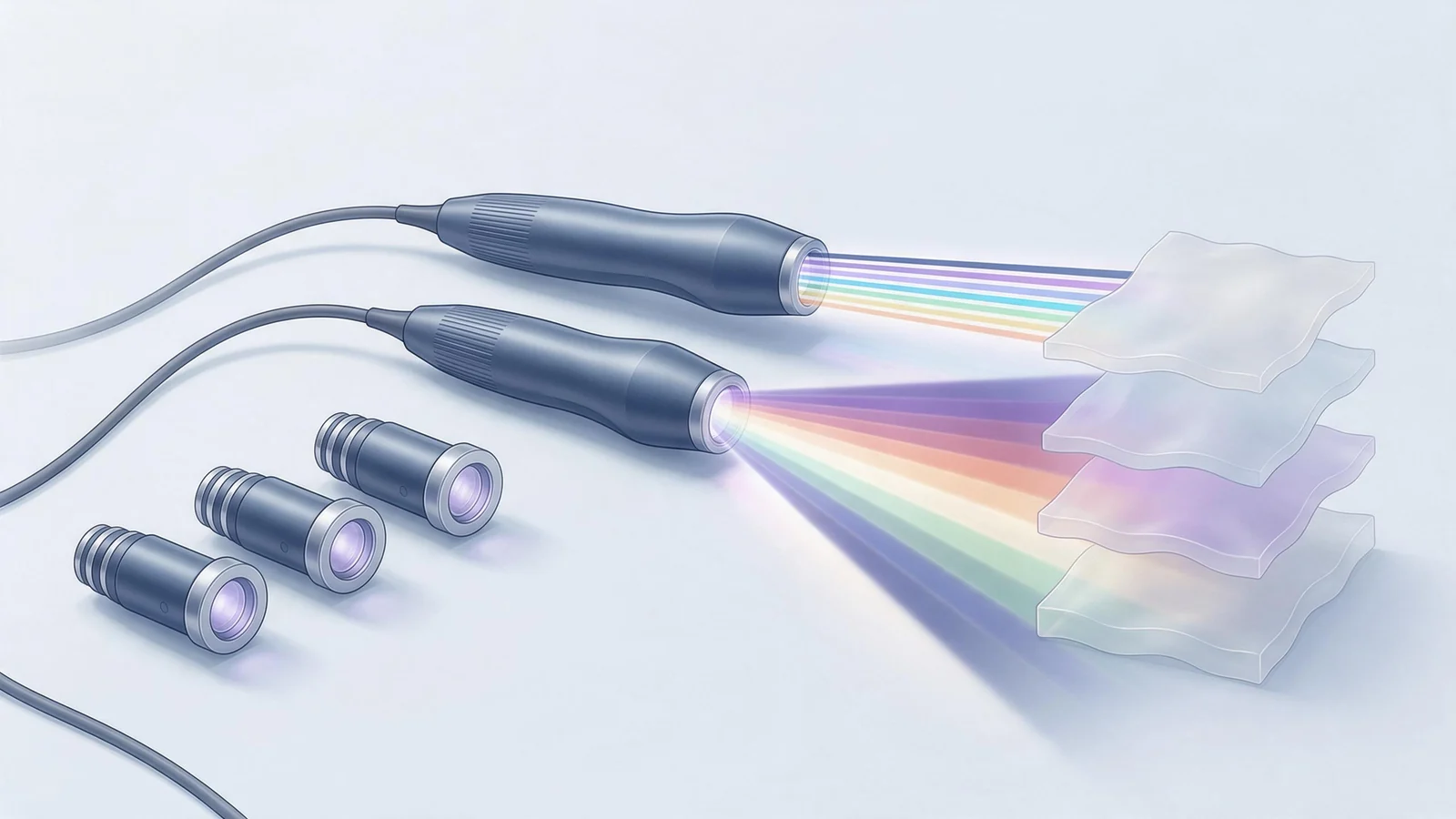
Start with the definition, because it settles most arguments. A DPL machine is an intense pulsed light device that filters its output down to a narrow band before it reaches the skin, rather than firing the full broad spectrum a conventional IPL uses. The FDA has been explicit about the underlying distinction for years: "IPL systems differ from lasers in that they deliver many wavelengths in each pulse of light instead of just one wavelength" (K230816 510(k) summary). DPL sits inside the IPL family. It is not a laser, it has no single coherent wavelength, and any supplier who tells you otherwise is either confused or selling.
Now the physics, in plain terms. Broadband IPL spreads energy across a wide window, so only part of each pulse matches what you actually want to heat. Melanin absorbs across a wide range, haemoglobin absorbs in its own bands, water absorbs elsewhere. Narrow the band and a bigger share of the delivered joules lands on the chromophore you're targeting instead of being absorbed by competing absorbers or scattered as heat you didn't ask for. That's the whole case for DPL in one sentence. It's a selectivity argument, not a power argument.
Here's where the marketing usually goes wrong. DPL is not universally superior to IPL, and it does not replace IPL for every indication. Narrow bands buy selectivity and pay for it in flexibility. If your case mix is broad, that trade can go against you, and I've watched clinics discover this only after the invoice cleared. Buy the platform that matches your booked treatments, not the one with the better brochure.
DPL vs IPL: spectrum, efficacy and treatment speed compared
Spectrum width drives everything downstream: what you can target, how forgiving the device is, and how many passes a session takes.
| Parameter | Narrow-spectrum DPL | Conventional broad-spectrum IPL |
|---|---|---|
| Emitted spectrum | Narrow filtered band, cut-off filters typically around 500-600 nm and above | Broad band, commonly 500-1200 nm with interchangeable filters |
| Selectivity per pulse | Higher for the target the band was chosen for | Lower, but spread across more chromophores |
| Indication flexibility | Narrow. One band, one job | Wide. Filter changes move you between pigment, vascular and hair |
| Skin-type range for hair removal | Band-dependent; narrow bands narrow your safe window | Wider, because you can swap to a longer cut-off |
| Session count | Reported as fewer for matched indications | Reported as more for the same endpoint |
| Throughput | Often faster per pass on a single indication | Slower per pass, but the same room handles more indication types |
On sessions: treat supplier "fewer sessions" claims the way you'd treat any other claim, which is to say, ask what the endpoint was and who measured it. Hair removal runs on biology, not enthusiasm. Growth is cyclic, with active anagen phases separated by quiescent telogen phases, and "only anagen hairs are particularly sensitive to physical insults at the time of hair removal" (Epilation today, PubMed). You are treating what's in the right phase when the patient walks in. No light source changes that.
Where broad-spectrum IPL still wins: versatility and hair removal across a wider range of skin types. If your schedule is pigment at ten, a vascular lesion at eleven and a hair removal course at noon, a single broadband platform with swappable filters keeps the room moving. A narrow-band unit does one of those three things beautifully and the other two poorly.
Clinical applications: where DPL fits for hair, pigment and vascular lesions
Pigment and vascular work is where narrow-band selectivity earns its place. Benign pigmented lesions, diffuse redness, small vascular lesions, photodamage: targets with a clear absorption peak reward a band chosen to sit on it.
Hair removal is the opposite story. The mechanism for photo-epilation is the same for lasers and IPL: "targeting melanin in the hair shaft, follicular epithelium, and hair matrix by emitting light with wavelengths ranging from 600 to 1200 nanometers" (Laser Hair Removal, StatPearls). That's a wide window, not a narrow one, which is why dedicated diode platforms and broad-spectrum IPL both do the job. On this site, the DL-07 diode laser hair removal platform runs 808 ± 10 nm with fluence from 2-80 J/cm2, pulse width 10-100 ms, spot size up to 12x12 mm, repetition rate 1-10 Hz and sapphire contact cooling at -4C. Those are hair-removal numbers, published in a table you can read. We also publish a multifunction platform, the MF-05 E-Light IPL + RF system, with a filtered IPL range of 530-1200 nm, IPL fluence of 10-45 J/cm2, 1 MHz RF at up to 100 W, a cut-off filter rejecting below 400 nm, sapphire contact cooling, and filter options of 530-1200 nm for rejuvenation, 585-1200 nm for vascular work and 610-1200 nm for hair.
Two cautions, and they matter commercially. Darker Fitzpatrick types need different parameters, and getting that wrong is how you generate post-inflammatory hyperpigmentation and a refund request in the same week. No single platform suits every patient, so a real consultation and patch test belongs in your protocol, and anything that looks malignant or clinically ambiguous should be referred rather than treated. That last line is the one that keeps clinics out of trouble.
Running costs: lamps, consumables and total cost of ownership
This is the section nobody on page one bothers with, and it's where the money actually is. A pulsed-light platform is a consumable business wearing a capital-equipment disguise. The xenon lamp is a wear item. Our device manuals rate the MF-05 xenon lamp at about 60,000 shots, and that single figure drives your recurring cost line more than any other number on the datasheet.
Here's a framework. Write down the lamp's rated shot life. Write down the replacement price and freight from the supplier, in writing. Then estimate shots per session for your most common treatment, because a large-area hair removal session burns far more shots than a small pigment spot. Divide replacement cost by rated shots to get cost per shot, multiply by shots per session, and you have your consumable cost per treatment. Add electricity, gel, disposables and staff time, then compare that against what you charge. If the payback maths only works at an unrealistic session volume, it doesn't work. Run the same calculation on every platform you're considering, side by side, before you negotiate anything.
Ask any supplier for lamp life figures, the measurement conditions behind them, and replacement pricing in writing. Ask what happens if the lamp fails early. A vendor who can't put those numbers on paper is telling you something useful.
Where DPL fits in an existing device lineup
Adding a narrow-band unit is additive when you have a specific, recurring case you're currently turning away or referring out. Say your books show a steady flow of pigment and vascular work that your current broad-spectrum IPL handles adequately but not quickly, and the room is booked solid. There, a fast narrow-band platform can raise throughput on your highest-volume indication without cannibalising anything. That's a real business case.
It's redundant when your existing IPL, with an appropriate filter, already covers that indication at acceptable speed. Two devices competing for the same patients and the same room don't double your revenue. They double your floor space and your training burden. Before buying, count your actual case mix over the last quarter by indication, not by what you'd like to be treating. If the new platform's best indication is under, say, a fifth of your bookings, the case for a second machine gets thin fast.
Then the unglamorous questions. Who runs it, and have they been trained on that specific band? What's the room's realistic throughput after setup, patch tests and paperwork? Does the case mix justify a second platform, or would a better filter set on the machine you own do the same job? DPL does not replace any other modality. It's an addition you justify with bookings.
Specification checklist: what to compare before you buy
Compare these parameters across every quote you collect:
- Wavelength bands and filter options. Which bands ship with the unit, which cost extra, and what cut-off is rejected.
- Fluence range in J/cm2, and whether the top of the range is usable on real skin or just on the datasheet.
- Pulse width range in ms, and whether multi-pulse and pulse-delay settings are exposed to the operator.
- Spot size. Small spots on large areas waste your staff's day.
- Repetition rate in Hz, which sets your ceiling on throughput.
- Cooling method and contact temperature, plus what happens if cooling fails mid-treatment.
- Lamp rated life in shots, stated in the manual rather than at the trade show.
One rule overrides all of it: a quoted number is only meaningful when the measurement conditions are stated. Fluence measured at the output window and fluence measured at the skin surface are different numbers, and suppliers know which one looks better in a table. On this site we publish the parameter tables for the models we list, and nothing beyond those tables, so you can compare like with like. If you want a worked example of spectrum choice in practice, our comparison of OPT versus conventional IPL covers the same trade-off from another angle.
Supplier due diligence: what to demand before you commit
Do this before any deposit leaves your account. First, ask for named regulatory clearance for the exact model you're buying, with the certificate or registration number, issued by the authority for your market. Not the brand. Not a sibling product. The model number on the crate. Second, ask for spare-parts availability in writing: which parts are stocked, lead times, and whether lamps and handpieces stay available for the life you expect from the machine. Third, ask for the training scope in writing, including who trains your staff, how many days, and whether follow-up training costs extra. Fourth, request references and independent test data rather than marketing claims, and don't accept a testimonial as a substitute for a measurement.
We're a manufacturer of laser, light and energy-based aesthetic equipment, and we quote per configuration. What we publish is specifications. What we don't publish is a price list, so you'll get a configuration-specific quote. Any supplier who dodges the clearance question, or answers it with a logo instead of a number, is answering it. Move on.
Questions buyers ask
What is a DPL laser treatment?
It's intense pulsed light run through a narrow filter, not a laser. A DPL machine emits a restricted band of wavelengths rather than one coherent wavelength, and that band is chosen to match a target such as melanin or haemoglobin. The clinical aim is more selective heating of the target while sparing surrounding tissue. Because it's still pulsed light, the usual IPL precautions apply: skin-type assessment, patch testing and realistic expectations about session counts.
Does the IPL device really work?
For the indications it's cleared for, yes, and the FDA summaries are blunt about which ones: certain intense pulsed light ranges are indicated for pigmented lesions, hair removal and vascular lesions, with 400-1200 nm indicated for acne. Hair reduction is defined as a long-term, stable reduction in regrowing hairs measured at 6, 9 and 12 months after a completed regimen. That's the standard to hold a supplier to. It isn't zero hair forever, and anyone promising that is overselling.
Does photorejuvenation really work?
Photorejuvenation is a cosmetic endpoint rather than a single regulated claim, so judge it by what's actually being treated: pigment, redness, texture and photodamage. Broad-spectrum IPL and narrow-band platforms both address these, with different selectivity. Results vary by skin type, lesion depth and protocol. Ask any supplier for the parameter range and the measurement conditions behind their claim, and set patient expectations at consultation rather than at the third session.
How many shots should I expect from an IPL lamp?
It varies by platform and by how hard you drive it, so treat any figure as a rated estimate rather than a promise. Our device manuals rate the MF-05 xenon lamp at about 60,000 shots. Whatever number a supplier gives you, get it in writing with the measurement conditions, then convert it into cost per treatment using your own shots-per-session figures. That conversion, not the headline number, is what tells you whether the machine pays for itself.
Evidence & further reading
Educational material for equipment selection and operator training. It is not medical advice, a treatment protocol or a promise of clinical outcome.